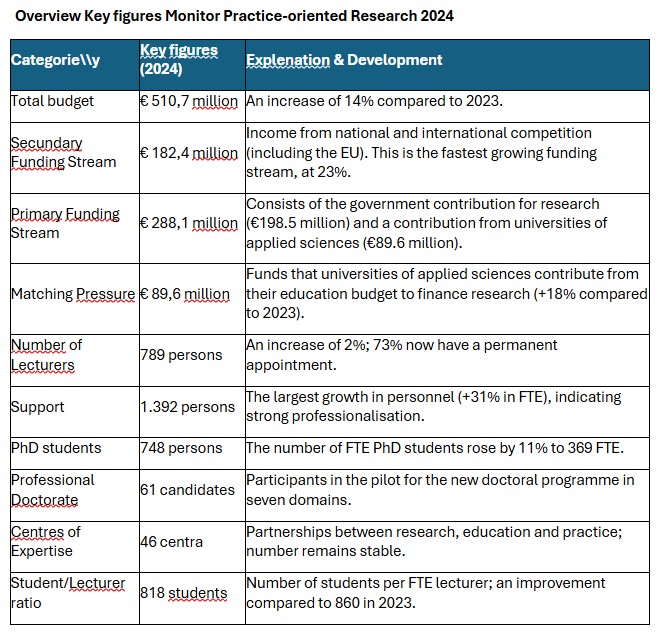
The results of the Rathenau Institute’s new Practical Research Monitor 2024 are clear: practiceoriented research at Dutch universities of applied sciences has come of age. With a record budget of over half a billion euros and a striking increase in competitive European funding, universities of applied sciences are confirming their role in the international knowledge infrastructure. From the perspective of the Universities of Applied Sciences Netherlands (UASNL) working group of the VH, we see this as a solid foundation for a future in which universities of applied sciences, regions and Brussels will increasingly find common ground in concrete innovation.
Back to overview
 Back to overview
The rise of practiceoriented research: universities of applied sciences are becoming increasingly established in Europe and the regions
A financial milestone: the power of competition
In 2024, total funding for practiceoriented research reached a historic level of 511 million euros, an increase of no less than 14% compared with the previous year. A large part of this growth came from the socalled second funding stream. This income, obtained through national and international competition, grew by 23%, the fastest of all funding streams.
This is an important signal for UASNL: it shows that research groups at universities of applied sciences are able to compete at the highest level. Total competitive and contractbased funding (second and third funding streams) has even grown by 249% since 2015. In concrete terms, this means that universities of applied sciences are becoming less dependent on government funding alone, and that markets and funders (national and European funding bodies) increasingly recognise the importance of practiceoriented research in generating socially relevant innovation.
Brussels in sight: UASNL as a strategic driver
The European ambitions of the 22 universities of applied sciences affiliated with UASNL are beginning to bear fruit. In 2024, universities of applied sciences were involved in a total of 80 successful European grant applications under prestigious programmes such as Horizon Europe and Interreg. In 19 of these cases, the university of applied sciences even acted as lead applicant, underlining the growing international recognition of their research.
UASNL is also increasingly acting as a strategic frontrunner. With our position paper Towards 2028 – Shaping the Future of the EU Framework Programme for R&I, we have set out ten concrete recommendations to embed the perspective of universities of applied sciences in future European research policy (FP10). As a result, we are no longer on the sidelines, but are playing a concrete and visible role in shaping the European research and innovation agenda.
Professionalisation: the research engine at full speed
Behind the positive figures lies a strong drive towards professionalisation. The monitor shows that support staff – such as grant advisers, project coordinators and data managers – have grown by 31% by 2024. This is a deliberate and profitable investment in the quality and continuity of research groups.
In addition, there has been a visible strengthening of the socalled research pyramid:
- The number of PhD candidates has increased by 11%.
- The pilot project with the Professional Doctorate (PD) is well on its way to being enshrined in law, with 61 candidates in seven domains.
- 73% of professors now have permanent appointments, which provides the necessary stability for longterm research programmes.
Regional impact and publicprivate synergy
Universities of applied sciences are increasingly becoming the connecting factor in regional knowledge ecosystems. With 46 Centres of Expertise and a strong focus on social themes such as health, the energy transition and a resilient society, they are making a tangible difference in the regions and in professional practice. Collaboration with businesses is more intensive than ever: in projects funded by the SIA steering body, 39% of partners are now SMEs. Striking examples include the development of sustainable bamboo textiles (ArtEZ), reducing alarm fatigue in ICUs (Windesheim) and crossborder bioconstruction in Brazil (Avans).
Looking ahead: challenges as fuel
Despite the positive outlook, there is still work to be done. The share of the primary funding stream (direct government contributions) fell from 64% in 2015 to 56% in 2024. This increases the socalled matching pressure: universities of applied sciences increasingly have to contribute their own resources in order to leverage external funding. In 2024, they contributed a total of no less than 90 million euros from their educational budgets to make practiceoriented research possible.
For UASNL, one thing is clear: practiceoriented research is an indispensable growth area for addressing major societal transitions. The Rathenau Institute’s Monitor PGO 2024 shows that universities of applied sciences are ready for the next step. UASNL therefore consistently calls on politicians, both at national and European level, to continue to support this successful model – because investing in universities of applied sciences is, ultimately, an investment in Europe’s innovative and inclusive future.